OUR STORY
ST MICHAEL-IN-THE-HAMLET WITH ST ANDREW CHURCH & HERITAGE CENTRE
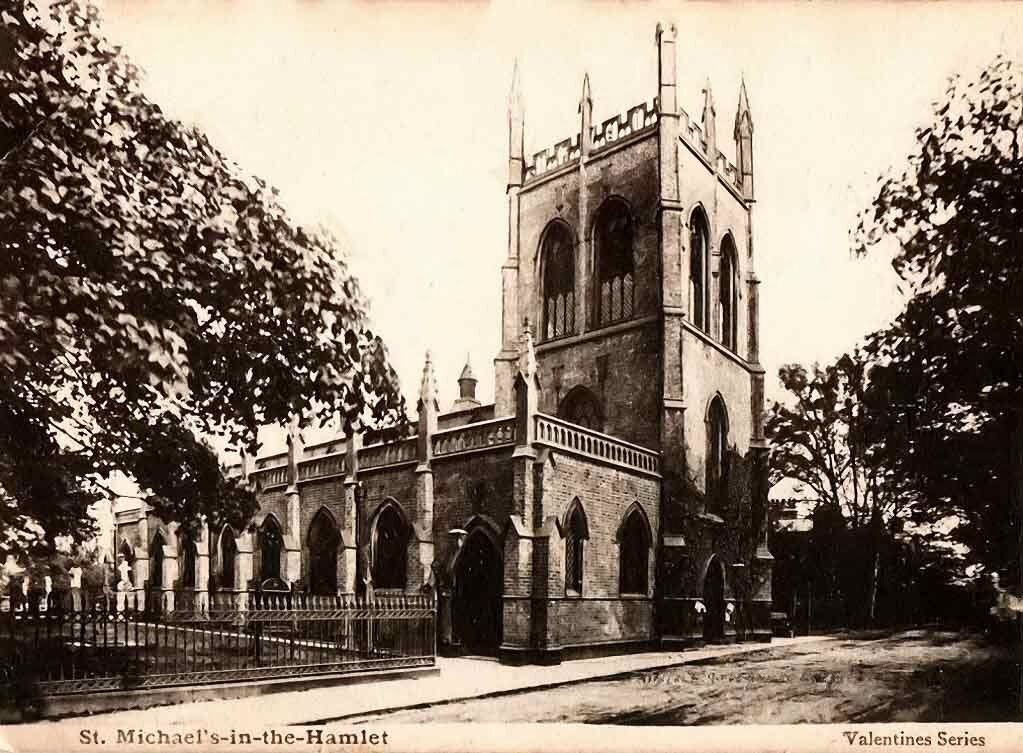
For more than 200 years, St Michael-in-the-Hamlet with St Andrew has stood at the heart of Aigburth. Built with pioneering cast-iron technology and shaped by generations of people who loved it, this church is a landmark not only of architecture but of memory, meaning and community life.

THE BEGINGING
The origins of St Michael-in-the-Hamlet with St Andrew are deeply connected to the stretch of the River Mersey known locally as the Cast Iron Shore, or simply “the Cazzy.” This shoreline — running from the Dingle to Otterspool — was once home to several iron foundries and iron shipbuilding works. The industry shaped both the landscape and the community; the shoreline itself became stained red by ferric oxide from iron production. It was a place of innovation and engineering skill, remembered even in popular culture through The Beatles’ song Glass Onion.
It was in this environment of industrial creativity that John Cragg, owner of the Mersey Iron Foundry on Tithebarn Street, envisioned a new kind of church. Cragg was a keen churchman and an early pioneer in using cast iron in architecture. After experimenting with cast iron in the construction of St George’s Church, Everton, he planned an even more ambitious approach for a church on the Cast Iron Shore.
Cragg purchased land from the Earl of Sefton and personally funded the building of the new chapel, which was constructed between 1813 and 1815 at a cost of £7,865 (around £570,000 in 2018 terms). Working with architect Thomas Rickman, he designed a structure unlike any other church in the country. Cast iron was used in place of stone for columns, window tracery, mouldings and ceiling details, as well as in the structural skeleton of the walls. Slate and brick were built around the iron frame, and the exterior was finished with stucco.
Despite tensions between Cragg and Rickman during the project, the result was a bold architectural achievement — a fusion of faith, engineering and innovation rooted directly in Liverpool’s industrial heritage. The new church was consecrated by the Bishop of Chester, George Henry Law, on 21 June 1815, marking the beginning of more than two centuries of worship, community and memory on this site.

A Landmark for Liverpool
When St Michael-in-the-Hamlet with St Andrew was completed in 1815, it immediately attracted national interest. An Act of Parliament recognised the need for a new place of worship in the rapidly expanding district of Toxteth Park, as the population outgrew the parish of Walton-on-the-Hill.
The church became an architectural landmark because of its extraordinary use of cast iron. Almost every structural and decorative element — columns, roof tracery, parapets, finials, mouldings, window surrounds and even the churchyard railings — was produced at Cragg’s foundry. The result was a building unlike any other in Liverpool or in the country.
Architectural historian Nikolaus Pevsner later wrote that Rickman “could not make Cragg’s iron bend to any beauty,” noting the tension between traditional Gothic design and industrial precision. Yet it is precisely this tension — between innovation and devotion — that makes St Michael’s a unique and irreplaceable part of Liverpool’s heritage.
REGENCY & VICTORIAN ERAS
By the late 1860s the structure of the building had deteriorated to the point where demolition was discussed. One of the churchwardens, Colonel Thomas Wilson, led a major restoration supervised by architects W. and G. Audsley. Box pews were removed, the floor was relaid, a heating system was installed and the interior was reconfigured with a central aisle and two side aisles.
In 1898 St Michael’s became a parish in its own right. As the congregation grew, the church was extended. The north wall was rebuilt further out, increasing the internal width of the church. A new porch was constructed, the vestry was relocated, and access to the west gallery was altered. The work cost £2,950 (around £330,000 today), raised entirely by parishioners.


The 20th Century
In 1902 the organ was moved from the west gallery to a position north of the chancel. Following the First World War, the money collected to celebrate the church's centenary in 1915 was used instead was used for improvements to the church. It was used to redecorate the interior, for the provision of a clock in the tower, and for a memorial window in the porch. In 1957 the Jubilee Chapel was created at the east end of the south aisle to commemorate the diamond jubilee of the Mothers' Union. A further renovation took place in 1984 when the pipe organ, that had been damaged by water, was replaced with an electronic organ. The oak reredos was removed from the sanctuary and the lower tier of stained glass was replaced in the east window. The gallery was converted into a choir vestry with a glass screen overlooking the interior of the church. Its cost was £8,000.

Structure & Architecture
St Michael-in-the-Hamlet Church is built in brick with many cast iron components; these include the parapets, battlements and pinnacles. The roofs are of slate slabs in a cast-iron framework. The plinth consists of a cast iron frame with slate covering. Its plan consists of a six-bay nave with clerestory, north and south aisles (the north aisle being wider than the south), a west tower, and a short chancel with a vestry to the north and a chapel to the south. The aisles, clerestory and tower have three-light windows with Perpendicular tracery. The tower also has paired three-light bell-openings, diagonal buttresses, an arcaded, embattled parapet and pinnacles. Inside is a six-bay arcade with cast iron columns. The windows are also made from cast iron.[8] An organ occupies the east bay of the north aisle and there is a west gallery.

WINDOWS
The stained glass in the east window is in early Gothic Revival style. The east window in the chapel dates from 1916 and is by Shrigley and Hunt. In the porch is a First World War memorial window with glass by H. Gustave Hiller.
Transition to the modern day
Today, St Michael-in-the-Hamlet with St Andrew stands as a rare survivor of early industrial innovation and over two centuries of community life. The next chapter of its story is focused on preserving this remarkable building for the future. To learn more about the restoration project — and how you can be part of it — visit our Heritage Restoration page.